Answering the search for a reliable tri-fuel inverter generator, this guide concentrates on models that run on gasoline, propane, and natural gas while delivering clean power for electronics. The top picks are best for home backup, camping, and job sites where fuel flexibility matters. They balance quiet operation, fuel efficiency, and portability. The following sections compare five strong options to help you choose the right fit for your needs and budget.
Summary of selected products:
| Product | Fuel Options | Best For | Why It Stands Out |
|---|---|---|---|
| Westinghouse 8200 Peak Watt Tri-Fuel iGen8200T Fc | Gas, Propane, Natural Gas | Home backup with 50A outlet | Strong peak power with inverter efficiency and CO sensor |
| Westinghouse 12000 Peak Watt Tri-Fuel iGen12000T Fc | Gas, Propane, Natural Gas | Whole-home backup | Large tank, long run time, low THD |
| WEN 14,500-Watt TF-1450X | Gas, Propane, Natural Gas | Transfer-switch readiness | High surge wattage and CO safety |
| GENMAX 6250w Tri-Fuel Silent Inverter (GM6250iET) | Gasoline, Propane, Natural Gas | Smart control features | Bluetooth APP, digital display, CO sensor |
| Champion 6500-Watt Tri Fuel Portable Inverter | Natural Gas, Propane, Gasoline | Remote start convenience | Wireless remote and transfer compatibility |
Westinghouse 8200 Peak Watt Tri-Fuel iGen8200T

The Westinghouse iGen8200TFc combines inverter power with tri-fuel capability. Gasoline provides 6600 running / 8200 peak watts; propane delivers 5940 running / 7380 peak; natural gas offers 5280 running / 6560 peak watts. It includes a 50A outlet suitable for home backup and a CO sensor for safety. Best for compact home use where quiet operation and fuel flexibility are priorities. Note that performance varies with fuel type and load, especially on natural gas which has lower peak output.
Who it’s best for: homeowners who want a reliable, switch-ready backup with a dedicated 50A circuit and enhanced safety features. Why selected: strong inverter efficiency, multi-fuel versatility, and transfer-switch readiness support essential home systems.
Caution: Natural gas performance is lower than gasoline; ensure your gas supply and line size support peak loads during outages.
Westinghouse 12000 Peak Watt Tri-Fuel iGen12000TFc

Designed for whole-home backup, this model provides up to 12,000W peak and 9,000W running on gasoline; 11,000W peak / 8,100W running on propane; and 9,800W peak / 7,200W running on natural gas. It’s built for quiet operation with Eco Mode and insulation to help keep noise around 64 dBA. A large 7.9-gallon tank supports extended runtimes, and a CO sensor plus low oil shutdown add safety. Best for larger homes or workshops that require sustained power and sensitive electronics protection.
Who it’s best for: households seeking substantial backup power with long runtimes and a flexible fuel approach. Why selected: high peak output, low THD, and a capacity designed for long outages.
Caution: Heavier unit; ensure proper lifting and safe storage in your space. Motor oil and maintenance are still required for optimal performance.
WEN TF-1450X Tri-Fuel Inverter Generator

The WEN TF-1450X offers gasoline, propane, and natural gas operation with high surge and running watts: 14,500 surge / 11,500 running on gas; 12,500 surge / 10,300 running on propane; 10,500 surge / 8,750 running on natural gas. It operates in 120V and 240V, making it suitable for transfer switches and emergency backup. The built-in CO Watchdog provides automatic shutdown on CO detection. Best for users needing robust power and transfer-switch compatibility in a single unit.
Who it’s best for: families and small businesses that require a strong all-fuels unit with transfer-switch readiness. Why selected: high power output with safety features and a flexible configuration.
Caution: Gasoline power is highest; propane and natural gas models may have lower peak outputs under certain loads.
GENMAX 6250w Tri-Fuel Silent Inverter (2026 Model)

The GM6250iET is a compact, tri-fuel inverter with 5500W running / 6250W starting on gasoline, and proportional ratings on propane and natural gas. It features 2-wire auto start/stop, Bluetooth app control, CO sensor, and a digital display. A 50A outlet is included for higher-demand loads, along with 120V outlets and USB ports. Best for tech-forward users who want remote control and monitoring from a phone or smart device.
Who it’s best for: homeowners and campers who value smart features and real-time fuel and load data. Why selected: advanced digital controls and safety sensors in a compact form.
Caution: Some users may experience a slower startup sequence with auto-start options; verify app compatibility and connection before heavy use.
Champion 6500-Watt Tri Fuel Portable Inverter
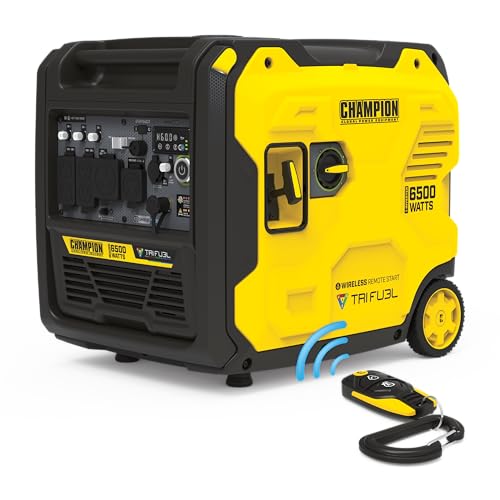
Champion’s 6500-watt model runs on natural gas, propane, or gasoline and includes hoses for natural gas (25 ft) and propane (6.6 ft). It supports remote starts up to 80 feet away and offers automatic transfer switch compatibility for easier home integration. Best for users who value long-range remote operation and flexible fuel connections. The kit options help set up with existing home infrastructure.
Who it’s best for: users seeking a convenient remote-start experience and easy integration with home backup systems. Why selected: strong fuel versatility with remote operation and transfer-switch compatibility.
Caution: Remote range and startup reliability may vary with battery condition; ensure a fresh battery for consistent starts.
Buying Guide
What to consider when choosing a tri-fuel inverter generator:
- Power needs: Match running and peak watts to your essential loads. Home backup usually benefits from higher peak and running wattage.
- Fuel flexibility: Tri-fuel capability protects against fuel shortages but check fuel-specific peak outputs and available fuel access.
- Inverter technology: Look for stable THD (total harmonic distortion) under 3-5% for sensitive electronics.
- Run time and tank size: Larger tanks provide longer runtimes between fills; consider your outage duration and fuel storage space.
- Noise level: Quieter operation improves usability in neighborhoods and campsites; verify decibel levels at representative loads.
- Safety features: CO sensors, low-oil shutdown, and GFCI outlets reduce risk during use.
- Transfer-switch readiness: If you plan to power a home circuit, ensure the model supports a transfer switch or interlock kit.
- Portability vs. capacity: Heavier units offer more power but require more handling; consider wheel kits and lifting options.
Frequently Asked Questions
- What is a tri-fuel inverter generator?
It is a portable generator that can run on gasoline, propane, or natural gas, using inverter technology to provide clean, steady power suitable for electronics.
- Why choose an inverter generator over a standard model?
Inverters regulate engine speed to match demand, improving fuel efficiency, reducing noise, and delivering stable power with low THD.
- Do tri-fuel generators require special installation?
Some models are transfer-switch ready or interlock kit compatible, which simplifies home backup integration. Check local codes and technician requirements.
- What should I consider for safety features?
Look for CO sensors, automatic shutdown for low oil or high CO, GFCI outlets, and proper fuel storage and ventilation guidelines.
- How do I choose the right fuel type?
Gasoline offers high power but shorter runtimes; propane and natural gas provide readily available options during outages, with trade-offs in peak output.
- Is a large fuel tank worth it?
Yes, for prolonged outages or remote locations, but ensure you have safe storage and space for the tank.