Selecting the right solar battery charger for an RV involves balancing wattage, durability, and ease of use. The following five options cover a range from compact, portable kits to full starter systems, all suitable for keeping RV batteries topped up during extended trips. Each product is designed to withstand outdoor use, with varying levels of charge-control intelligence to match different battery chemistries and budgets.
| Product | Brand | Power (W) | Key Feature |
|---|---|---|---|
| Renogy 100W Foldable Solar Panel Kit | Renogy | 100 | Portable foldable suitcase with 20A PWM controller |
| Renogy 100W Solar Starter Kit | Renogy | 100 | 30A LCD PWM controller and complete installation kit |
| SOLPERK 50W Solar Panel Kit | SOLPERK | 50 | Waterproof controller; durable aluminum frame |
| SOLPERK 20W 12V Solar Panel Kit | SOLPERK | 20 | Upgrade controller; compact and rugged |
| SUNER POWER 30W Solar Battery Charger Kit | SUNER POWER | 30 | Ultra-Smart MPPT with weatherproof design |
Renogy 100W Foldable Solar Panel Kit

The Renogy foldable 100W solar suitcase includes a 20A waterproof charge controller and alligator clips, designed to pair with a range of 12V batteries. The kit’s plug-and-play setup simplifies adding solar to an RV electrical system or expanding an existing array. Its foldable design makes transport and storage straightforward for RV travelers who need rapid deployment at campsites or backcountry stops. The panel uses grade A monocrystalline cells, and the PWM controller manages charging safely and efficiently, helping protect battery health during long trips.
Portability is a central feature: the suitcase is compact when closed and unfolds into a sturdy 100W solar surface in minutes. For RV enthusiasts who want a flexible charging option without a complex installation, this kit offers a solid balance of performance and convenience. Its compatibility with multiple 12V battery types also makes it suitable for various RV setups, from cranking aids to auxiliary power systems. While ideal for supplemental charging, users should plan for sufficient mounting space and consider a larger array if daily energy needs are high.
Renogy 100W Solar Panel Starter Kit

The Renogy 100W Starter Kit combines a high-efficiency 100W monocrystalline panel with a 30A LCD PWM charger controller, inline with an adaptor kit, tray cables, and mounting hardware. This kit is designed for RV users seeking a reliable, more integrated solar solution that can be installed on a roof or in a preferred mounting area. With a reported panel efficiency around the mid-20s percent range and UL 61730 and other safety certifications, the system emphasizes safety and long-term operation in varying weather conditions. The included controller’s LCD readout helps monitor charging status, battery health, and system performance.
For RV applications, this starter kit provides a balanced approach: strong solar generation, straightforward installation, and robust protection against overcharging and short circuits. It is well-suited for campers who want a dependable, somewhat more permanent solar upgrade without diving into high-cost, high-complexity tech. Those planning daily usage or larger battery banks may eventually scale to higher-wattage modules, but this kit offers a solid foundation for off-grid power readiness.
SOLPERK 50W Solar Panel Kit
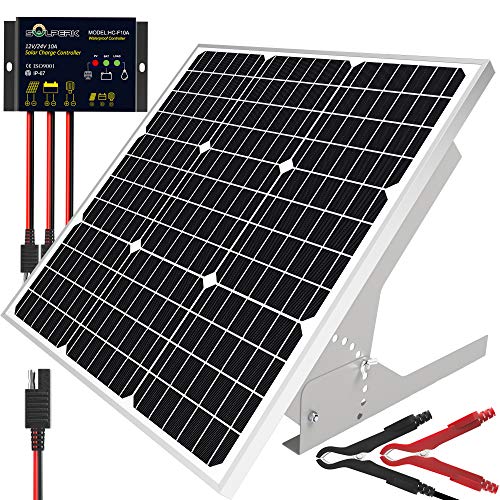
The SOLPERK 50W kit brings a mid-range option with a 50W panel and a waterproof controller, designed for a variety of 12V battery chemistries including LiFePO4 and AGM. The kit’s 21%-30% cell efficiency range reflects solid real-world performance for RVs needing steady trickle charging and occasional top-offs during trips. The system uses a low-iron tempered glass surface and an aluminum frame, making the panel resistant to corrosion and capable of withstanding typical outdoor exposure. Its IP65-rated controller helps prevent overcharging and provides clear status indicators for easy monitoring on the road.
Durability and weather readiness are core to this option, which aims to endure travel and campsite conditions. The 50W output is suitable for smaller or secondary battery banks or for topping up an existing system rather than serving as a sole power source for heavier daily loads. RV owners with limited roof space or who rely on generator-free travel will appreciate the compact design and straightforward setup of this kit.
SOLPERK 20W 12V Solar Panel Kit
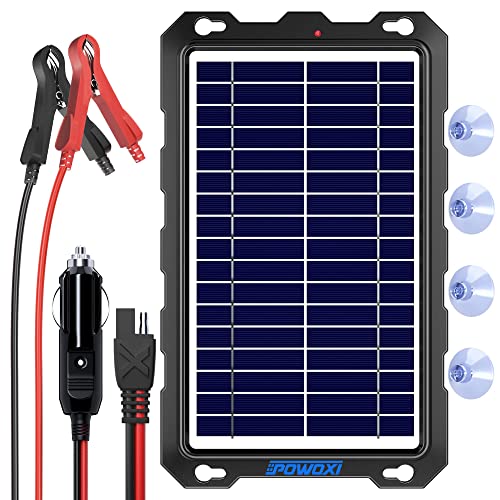
The SOLPERK 20W kit presents a compact, lightweight option for RV owners who want an easy-to-carry charging solution. It features an upgraded 8A controller and a high-efficiency monocrystalline panel, designed to charge and maintain a range of 12V batteries. The setup emphasizes weather resistance with a sturdy frame and glass construction suitable for outdoor use. It’s a practical add-on for days when extra charging capacity is not required but consistent battery maintenance is beneficial. While not a primary power source, this kit helps protect battery life during extended stays or frequent travel between campsites.
Smart charging and safety are central to this kit, with built-in protections against overcharging and short circuits. For RV users who need a small, reliable solution to keep auxiliary batteries topped up during travel or camping trips, the SOLPERK 20W kit offers a balance of portability and dependable performance without overwhelming installation needs.
SUNER POWER 30W Solar Battery Charger Kit

The SUNER POWER 30W kit emphasizes an Ultra-Smart MPPT charge controller, delivering high tracking efficiency up to 99% and peak conversion efficiency around 98%. This design aims to maximize energy harvest in varied sun conditions, a benefit for RV trips with limited sunlight windows. The improved three-stage charging (Bulk, Absorption, Float) supports safe, efficient battery recharge and extended battery life. The system includes full protection against over-charge, over-discharge, over-voltage, over-current, short circuits, and temperature threats, with waterproofing to withstand RV camping environments. It’s a practical, all-weather option for travelers who want robust monitoring and automation.
For RV users, the SUNER POWER 30W kit offers a compact, weather-ready solution with MPPT advantages, making it a compelling choice when space is at a premium but automatic maintenance and protection are priorities. It pairs well with mid-size battery banks and can be a dependable complement to a larger solar setup or a supplement to a generator-free camping routine.
Buying Guide
Key purchase considerations
Size the system to your typical daily consumption. RVs with refrigerators, lights, and charging needs may require higher wattage panels and larger battery banks. Consider your roof space, weight limits, and whether you prefer a portable panel or a fixed-roof installation. Compatibility with your battery chemistries (AGM, flooded lead-acid, LiFePO4, etc.) is essential, as is the ability to expand the array later if power needs grow.
MPPT vs PWM controllers
MPPT controllers maximize energy harvest, especially in cooler mornings, partial shading, or when the panel voltage is far from the battery voltage. They are typically more efficient but come at a higher upfront cost. PWM controllers are simpler and cheaper and work well for smaller systems or where budget is a primary constraint. For RV users pursuing reliable off-grid power, MPPT-based kits—like the SUNER POWER option listed here—offer tangible efficiency gains, particularly when battery banks are larger or solar conditions vary.
Durability and weather resilience
Look for waterproof, dustproof, and impact-resistant enclosures. Panels with tempered glass, corrosion-resistant frames, and weatherproof controllers are better suited for road trips and camping in varying climates. Certifications such as UL 61730 and IP ratings provide assurance of safety and performance under common RV conditions.
Installation and portability
Portable foldable kits are easy to deploy and store but may require a stable mounting approach when used in RV parks or on uneven ground. Fixed-roof kits demand more permanent mounting but can maximize space and aesthetics. Assess mounting hardware needs, cable routing, and whether you’ll rely on battery clamps, ring terminals, or dedicated bus bars for connection to the RV’s electrical system.
Cost, warranty, and service
Compare the total cost of ownership, including cables, connectors, and mounting hardware. A longer warranty on panels and controllers provides peace of mind for off-grid use and frequent travel. Some brands offer extended service plans covering material workmanship and output, which can be valuable over several seasons of RV trips.
System sizing example
For an RV with a 100Ah LiFePO4 battery bank and daily usage of LED lighting, a small fridge, and phone charging, a 100W panel can sustain daytime charging and help maintain the battery. If daily energy needs rise (e.g., running a residential fridge, water heater, or inverter draws), consider adding another panel or upgrading to a larger kit with a higher-wattage panel and a controller designed for expanded capacity.
Bottom-line considerations
Choose a kit that fits your space, budget, and energy goals. A foldable 100W kit offers portability and quick setup, while a larger starter kit provides more complete system integration for steady RV power. MPPT-based controllers generally deliver better efficiency for more demanding users, but PWM kits can be perfectly adequate for lighter, supplementary charging. Prioritize weather resistance, warranty, and the ability to scale the system as your RV adventures grow.