Direct answer: This guide highlights top roof-mounted RV air conditioners that balance cooling power, energy efficiency, and ease of installation. It targets weekend campers, full-time travelers, and van-build enthusiasts seeking reliable comfort on the road. Below, you’ll find five models chosen for performance, versatility, and practical use in a variety of RV sizes. A quick buyer’s table helps compare core specs at a glance.
Product snapshot
| Product | BTU / Heat | Type | Best For |
|---|---|---|---|
| Furrion Chill Cube 18K Non-Ducted | 18,000 BTU | Non-Ducted | Large cab/RV spaces, off-grid trips |
| Arsenda 18,000 BTU with Heat Pump (110-120V) | 18,000 BTU cooling / 10,236 BTU heating | Heat Pump | All-season comfort in mid-to-large RVs |
| Arsenda 18,000 BTU Non-Ducted | 18,000 BTU cooling / 10,236 BTU heating | Non-Ducted | Quiet cooling with simple roof install |
| VEVOR 13,500 BTU Non-Ducted | 13,500 BTU | Non-Ducted | Compact RVs and vans |
| TURBRO 15,000 BTU with Heating | 15,000 BTU cooling / 1,500 W heat | Non-Ducted | All-season RVs needing warmth mode |
Furrion Chill Cube 18K Non-Ducted Rooftop AC

The Furrion Chill Cube 18K Non-Ducted Rooftop AC delivers up to 18,000 BTU of cooling with a focus on efficient performance for campervans and mid-size RVs. It uses a variable-speed compressor to move air more effectively and maximize cooling while minimizing energy use. Installation is bolt-on with a clear guide; note that this listing is for the AC unit only, with the ducting and components sold separately. Best for campers and van dwellers who want strong, off-grid capable cooling without a ducted system.
Who it’s best for: buyers needing robust cooling power in a non-ducted roof setup, especially when off-grid runtime matters. Why selected: high capacity paired with energy efficiency and straightforward bolt-on installation. Caution: ADB and installation components may be needed separately, increasing setup steps and total cost.
Arsenda 18,000 BTU RV Air Conditioner With Heat Pump

This Arsenda model combines 18,000 BTU cooling with a 10,236 BTU heating output via a heat pump. It’s designed for RV interiors up to about 680 square feet and requires both 115V AC and 12V DC power to operate. The unit aims to provide all-season comfort with relatively quiet operation compared to many traditional RV AC systems. Best for: RVs needing reliable cooling and heating from a single rooftop unit. Why selected: strong all-season performance and compatibility with standard RV electrical setups. Caution: dual-power connections add wiring considerations during installation.
Arsenda 18000 BTU Rooftop Non-Ducted RV AC
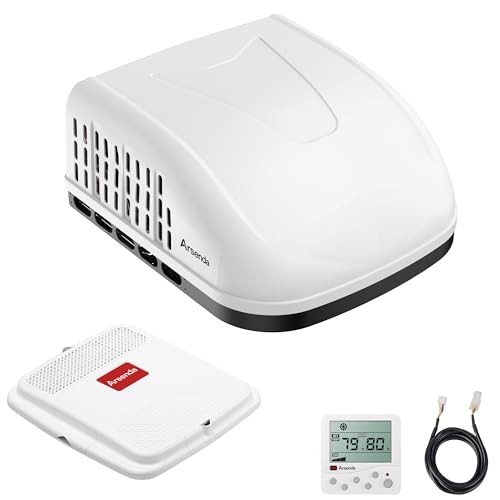
This Arsenda non-ducted unit provides 18,000 BTU of cooling with 10,236 BTU heating, suitable for RV spaces up to 680 sq ft. It emphasizes quiet operation around 50 dB and requires both 115V AC and 12V DC connections. Best for: RVs where a non-ducted, roof-mount setup is preferred for simplicity and maintenance. Why selected: balance of cooling power and relatively low noise. Caution: installation planning should account for power wiring needs and vent clearance.
VEVOR RV Air Conditioner 13,500 BTU Non-Ducted

VEVOR’s 13,500 BTU non-ducted unit is designed for medium-sized RVs and campers. It offers three modes (Auto, Cooling, and 3-Speed Fan) with a simple control panel and a built-in timer. The included air distribution box and installation hardware simplify roof mounting, and the unit is optimized for standard rooftop vent dimensions. Best for: smaller to mid-sized RVs where a cost-effective, easy-to-install option is desired. Why selected: compact capacity with flexible operation modes. Caution: not compatible with ducted RV systems.
TURBRO RV Air Conditioner 15,000 BTU With Heat

The TURBRO unit delivers 15,000 BTU of cooling and doubles as a heating source with a 1,500W electric heater. It also includes fan and dry modes, aiming to cover diverse weather needs. It’s controllable via remote or app, and features an atmosphere lighting option for the ceiling. Best for: RVs requiring reliable cooling plus reliable heating, plus modern control features. Why selected: higher heat capability for shoulder seasons. Caution: heating performance depends on electrical supply and climate conditions.
Buying Guide: Key Purchase Considerations
- RV size and ceiling height: Match BTU to cabin area and insulation level. Larger spaces demand higher cooling capacity.
- Power source and wiring: Check whether the unit requires 115V AC, 12V DC, or both. Ensure your RV electrical system can support peak loads.
- Non-ducted vs ducted: Non-ducted units are simpler to install and suited for straightforward roof installations; ducted systems offer integrated airflow but require more components.
- Noise level: Look for units around 50 dB or lower for comfortable conversation during rest or work.
- Heating capability: If you need all-season comfort, consider models with heat pump or electric heating and understand heating efficiency in cold climates.
- Installation considerations: Bolt-on installation vs built-in kit; include required components and potential need for professional help.
- Energy efficiency: In off-grid scenarios, models with variable-speed compressors or eco modes help maximize battery runtime.
- Maintenance and accessibility: Consider ease of cleaning filters, replacing parts, and accessibility of the rooftop unit.
Frequently Asked Questions
- What size RV roof AC do I need? Answer: It depends on space (square footage), insulation, and climate. Larger RVs generally require higher BTU units (15,000–18,000 BTU) for effective cooling.
- Can I install a roof AC myself? Answer: Many non-ducted units offer bolt-on installation with a step-by-step guide. Some models require additional components or electrical work.
- Do non-ducted RV ACs cool as well as ducted ones? Answer: Non-ducted units can provide strong cooling, especially in open-plan RVs, but ducted systems may distribute air more evenly in long layouts.
- Is a heat pump necessary for all-season comfort? Answer: A heat pump is beneficial for heating in moderate climates; extreme cold may require supplemental heating.
- Should I prioritize energy efficiency or raw cooling power? Answer: For off-grid use, prioritize energy efficiency and compressor control (e.g., variable-speed) to extend battery life.
- What maintenance is required for rooftop ACs? Answer: Regularly inspect seals, clean or replace filters, and ensure the drainage and wiring are secure and dry.