Answer: Choose a high-quality motor oil matched to your vehicle’s needs, and pair it with a compatible oil filter to protect engines from wear, deposits, and leaks. This guide highlights five top options and explains who each product is best for, helping you decide quickly and confidently.
| Product | Best For | |
|---|---|---|
| Valvoline Advanced Full Synthetic SAE 5W-30 | Modern engines needing strong wear protection | 40% stronger wear protection; cleaner deposits; fuel economy support |
| Valvoline MaxLife High Mileage Full Synthetic 5W-20 | High-mileage vehicles (75k+ miles) | Seal conditioners; 50% stronger wear protection |
| Valvoline Advanced Full Synthetic 0W-20 | Fuel-efficient daily drivers | Same advanced protection as 5W-30 with thinner 0W-20 grade |
| Valvoline MaxLife High Mileage Synthetic Blend 5W-30 | Older engines with leaks or oil consumption | Seal conditioners; reduced leaks and consumption |
| Castrol GTX Full Synthetic 0W-20 or 5W-30 | Value-conscious drivers seeking robust protection | Strong wear and sludge protection; viscosity stability |
Valvoline Advanced Full Synthetic SAE 5W-30 Motor Oil 5 QT

Best for modern engines that demand strong wear protection and deposit defense. This oil targets wear, friction, heat, and deposits, delivering 40% stronger wear protection than industry benchmarks and 15% better deposit defense. It supports smoother performance and longer lasting protection, making it suitable for daily drivers and performance-minded vehicles. This is a strong pick for drivers seeking extended engine cleanliness and efficiency. Caution: ensure correct viscosity for your vehicle’s manufacturer recommendations.
Valvoline MaxLife High Mileage Full Synthetic 5W-20 Motor Oil 5 Quart

Best for vehicles with 75,000 miles or more. This oil uses seal conditioners to help prevent leaks and reduce oil consumption while delivering 50% stronger wear protection. It’s a solid choice for older engines facing increased wear and potential seals drying out. Limitations include references to high mileage care rather than new-engine demands; verify compatibility with your service interval needs.
Valvoline Advanced Full Synthetic SAE 0W-20

Best for fuel-efficient daily drivers seeking the same advanced protection as 5W-30 but in a thinner 0W-20 grade. It guards against wear, friction, heat, and deposits, delivering 40% stronger wear protection and improved deposit defense. Choose this if your manufacturer calls for 0W-20 or if you aim to maximize efficiency without sacrificing protection. Limitation: not ideal where higher viscosity is recommended by the engine spec.
Valvoline MaxLife High Mileage 5W-30 Synthetic Blend
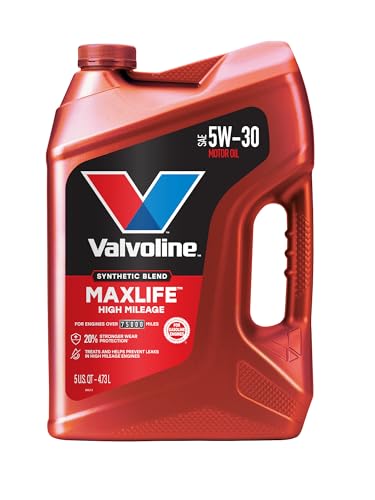
Best for older engines needing robust protection with reduced leaks. This synthetic blend targets high-mileage concerns with 20% better wear protection and 15% better sludge defense. It includes extra detergents to guard against friction, corrosion, and deposits. Not ideal for new engines that require modern full synthetic formulations beyond high-mileage blends.
Castrol GTX Full Synthetic 0W-20 5 Quarts

Best for drivers seeking strong wear and sludge protection with reliable viscosity stability. GTX Full Synthetic 0W-20 offers 6X better wear protection on critical parts and 1.3X better sludge protection than industry standards, plus three times stronger resistance to viscosity breakdown than leading full synthetics. Choose this for a balance of protection and efficiency. Limitation: performance claims are comparative to industry standards, not universal across all engines.
Castrol GTX Full Synthetic 5W-30

Best for drivers who want strong protection across temperature ranges with dependable sludge defense. Benefits include 6X better wear protection and improved sludge handling similar to 0W-20 variants, scaled for 5W-30 applications. Use this if your engine calls for 5W-30 and you want robust protection across seasons. Caution: viscosity choice should match manufacturer recommendations.
Castrol EDGE 0W-20 Advanced Full Synthetic

Best for high-stress, modern engines requiring top-tier protection and extended oil-change intervals. EDGE 0W-20 claims three times stronger protection than leading full synthetics and 10X better high-stress performance, with claimed up to 20,000 miles between changes in some contexts. Choose this if you want premium protection and long-change intervals. Limitation: high-end performance claims may align with specific vehicle guidelines.
Polaris PS-4 Full Synthetic 5W-50 Engine Oil

Best for powersports engines and extreme temperatures. The full synthetic base and 5W-50 viscosity provide protection across a wide temperature range (-40°F to 100°F) and aim to extend engine life in demanding conditions. It includes a custom additive system to reduce deposits and component wear. Limitation: tailored more toward powersports engines; verify compatibility with automotive engines before use.
Buying Guide: Key Purchase Considerations
- Engine type and age: Choose high-mileage blends for older engines and full synthetics for newer models.
- Viscosity grade: Follow manufacturer recommendations; 0W-20 and 5W-30 are common for modern engines.
- Protection needs: If you notice deposits, look for enhanced deposit defense; for leaks, consider seal conditioners.
- Driving conditions: High temperatures, towing, or cold starts can influence oil choice and change intervals.
- Blend vs full synthetic: Full synthetic provides strong protection across conditions; blends can offer value with adequate protection.
- Warranty and vehicle guidelines: Always align with your vehicle’s manual and warranty requirements.
Frequently Asked Questions
- What oil viscosity should I use for a modern engine?
Answer: Follow the vehicle’s owner manual; common choices are 0W-20 or 5W-30 for many modern engines. - Is high-mileage oil better for older cars?
Answer: Yes, high-mileage formulations include seal conditioners and wear protection tailored for engines with 75,000 miles or more. - What’s the difference between full synthetic and synthetic blend?
Answer: Full synthetic offers maximum protection and stability; blends combine synthetic and conventional oils for cost and performance balance. - Can I switch between brands?
Answer: Yes, but ensure correct viscosity and compatibility with your engine; consult the owner’s manual if in doubt. - How often should I change oil?
Answer: Change intervals vary by engine and driving conditions; follow manufacturer guidelines and consider driving style and climate. - Do oil filters matter as much as oil?
Answer: Yes. Oil filters help remove contaminants; pairing a quality filter with oil is essential for engine protection.