The right OBD2 scanner makes it straightforward to read and clear engine codes, view live data, and verify repairs. This guide highlights five top picks that balance ease of use, breadth of features, and clear data for different DIYer needs. Best for: casual drivers who want quick checks, hobbyists who troubleshoot on their own, and semi-professional users who need deeper data without dealership prices.
Summary of selected products
| Product | Best For | Key Benefit | Limitations |
|---|---|---|---|
| ANCEL AD410 Enhanced OBD2 Scanner | Beginners to DIYers | Comprehensive OBD2 diagnostics with built-in DTC lookups | Limited ABS/SRS depth on some models |
| FOXWELL NT301 | New DIYers | One-click CEL read/clear; clear pass/fail indicator | Basic live data; not a full bi-directional tool |
| FOXWELL NT604 Elite | Serious DIYers | 5-in-1 coverage (ABS/SRS/engine/transmission) with live data | More advanced; may have a learning curve |
| MOTOPOWER MP69033 | Budget-conscious buyers | Wide protocol support; clear LCD display | Interface and data depth not as deep as higher-end tools |
| Innova 5610 | Professional/advanced DIYers | Bidirectional capabilities for troubleshooting and resets | Higher price; not universal across all makes/models |
ANCEL AD410 Enhanced OBD2 Scanner

The AD410 provides broad OBDII coverage with a strong built-in DTC library. It reads and clears engine fault codes, displays code definitions, and supports I/M readiness checks. Best for users who want quick insight into the cause of a check engine light and straightforward vehicle data, without needing a premium bidirectional tool. Some models may have limited depth for ABS/SRS beyond standard codes.
Who it’s best for: Beginners and DIYers who want reliable code reading and clear explanations quickly. Choose this if you want a balance of ease-of-use and diagnostic depth for typical emissions issues.
Why selected: It offers a solid, proven feature set with practical on-screen definitions and ready-to-use data, aiding faster repairs and clearer communication with mechanics.
One caution: The device focuses on standard OBDII functions; advanced ABS/SRS diagnostics might require a higher-end tool.
FOXWELL NT301 OBD2 Scanner

The NT301 is designed for quick diagnostics and basic repair validation. It reads and clears engine fault codes, displays live data, and provides a dedicated I/M readiness status. It’s ideal for DIYers who want a fast, reliable tool that can indicate whether a vehicle is ready for inspection tests. It does not offer the full suite of bi-directional tests found in higher-end models.
Who it’s best for: New and casual DIYers who want simple, fast checks and honest feedback about readiness status before an inspection.
Why selected: Its ease of use and one-click feedback help avoid unnecessary trips to the shop, while still delivering essential diagnostic information.
Caution: Limited live data depth compared with multi-system scanners; may not cover all specialist codes for some makes.
FOXWELL NT604 Elite OBD2 Scanner

The NT604 Elite expands to five-in-one capabilities: general OBDII diagnostics plus ABS/SRS and transmission checks, with live data, data playback, and print options. It’s designed for car owners who want more information before deciding on repairs and for those who need to verify readiness for inspections. Note that it cannot perform powertrain resets without repair work and does not replace a true workshop tool for certain procedures.
Who it’s best for: Car owners who want deeper insights beyond engine codes and who may be preparing for state inspections or trying to diagnose intermittent issues in multiple systems.
Why selected: Its 5-in-1 approach makes it a versatile option for users who want broader system visibility without a steep cost.
Limitation: It requires proper repair steps to clear some fault indicators; it does not perform all reset or relearn procedures like dealer tools.
MOTOPOWER MP69033 Car OBD2 Scanner

The MP69033 offers broad protocol support for most 1996 US, 2000 EU, and Asian vehicles, plus real-time data, I/M readiness, and vehicle information. Its 2.8″ LCD with backlight makes data easy to read, and it powers directly from the vehicle’s OBDII port—no separate battery requirement. Best for budget-conscious buyers who still want a capable, portable scanner.
Who it’s best for: Budget-minded DIYers who need a broad protocol scope and an easy-to-read display for everyday diagnostics.
Why selected: It covers many common car systems and provides clear live data without extra accessories.
Limitation: Fewer advanced features compared with premium models; data depth is adequate for typical codes and live data but not all system tests.
VDIAGTOOL VD10 OBD2 Scanner
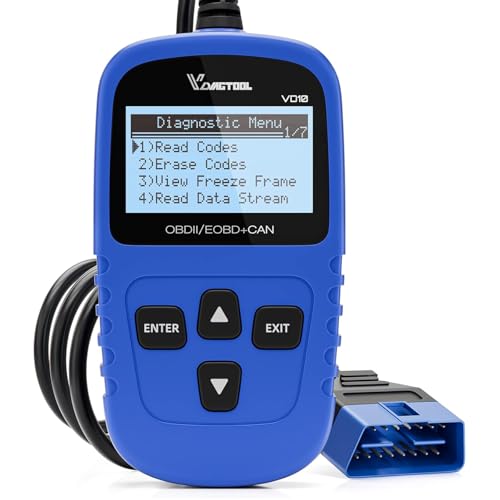
The VD10 focuses on essential DTC reading and clearing, freeze frame, I/M readiness, and basic vehicle information. It’s presented as a user-friendly option for DIYers who want a straightforward tool to diagnose and clear engine faults and monitor MIL status. It follows a similar philosophy to fixes-it-yourself devices but with built-in DTC lookup for faster interpretation.
Who it’s best for: Casual DIYers who want a simple, reliable tool for daily checks and code clearing.
Why selected: Practical features like freeze frame and internal DTC definitions provide quick, actionable insights without overcomplication.
Innova 5210 OBD2 Scanner

The Innova 5210 combines OBD2 scanning with a battery tester, offering live data and emission-related diagnostics. It’s well-suited for users who want to monitor battery health alongside engine codes, making it a practical all-in-one option. Coverage is extensive but varies by vehicle make and year, so verify compatibility for specific cars.
Who it’s best for: Those who want combined engine diagnostics and battery health checks in one tool.
Why selected: Combines essential code reading with real-time engine data and battery testing for a broader car-health overview.
Limitation: Not universal for all makes/models; verify coverage prior to purchase.
Buying Guide: Key Considerations For Your OBD2 Scanner
- Purpose and scope: If you only need quick codes and I/M readiness, a basic model like NT301 may suffice. For multi-system diagnostics or professional use, consider NT604 Elite or Innova 5610.
- Bi-directional capabilities: Tools with bidirectional control (e.g., Innova 5610) can run tests and commands to certain subsystems. This is useful for more advanced troubleshooting but comes at a higher price.
- Live data depth: If you want deeper insight into engine performance (RPM, temps, fuel trims), ensure the device supports robust live data streaming and data playback.
- Vehicle compatibility: Most OBD2 tools cover 1996+ US, EU, and many Asian vehicles, but check the manufacturer’s compatibility list for your make/model.
- Interface and usability: A clear display, intuitive menus, and a readable code glossary improve speed and accuracy, especially for beginners.
- Data storage and reporting: Some models allow data export or printing; this is helpful if you need to document findings for a technician.
FAQ
- What does an OBD2 scanner do? It reads and clears diagnostic trouble codes, displays live engine data, and helps determine the cause of the check engine light.
- Do I need a bidirectional scanner? Not for everyday fixes. Bidirectional tools are more advanced and price higher, suitable for professional diagnostics and resets.
- Will these work on all cars? Most 1996 and newer vehicles sold in the US, EU, and many Asia models are OBD2 compliant, but verify compatibility for your specific make and year.
- Can I use these devices to pass an emissions test? Some models offer I/M readiness checks to help prepare for inspections, but verify local requirements and test readiness status.
- Do these devices require a battery? Most plug directly into the vehicle’s OBDII port and draw power from the car; some handheld models have batteries or internal power options.