The best marine battery for a trolling motor depends on the runtime you need, your boat’s weight limits, and whether you prefer lead-acid or lithium. The Newport 12V 50Ah AGM is a lightweight sealed lead-acid option; the SUPER EMPOWER and Lithova 100Ah batteries are lithium choices for longer-capacity needs; LiTime highlights marine-focused protections; and Mighty Max offers a smaller 55Ah AGM battery.
| Battery | Type and capacity | Best for |
|---|---|---|
| Newport 12V 50Ah | Sealed AGM, 50Ah | Buyers seeking a portable AGM battery |
| SUPER EMPOWER 12V 100Ah | LiFePO4, 100Ah | Lightweight deep-cycle energy storage |
| Lithova 12V 100Ah | LiFePO4, 100Ah | Lead-acid upgrades and cycle-life claims |
| LiTime 12V 100Ah | LiFePO4, 100Ah | Marine use and cold-weather protections |
| Mighty Max 12V 55Ah | Sealed SLA/AGM, 55Ah | Mid-capacity sealed lead-acid power |
Newport 12V 50Ah AGM Marine Battery

Best for: Boat owners who want a comparatively light, sealed lead-acid battery for a compatible 12V trolling motor. Newport lists the battery at 32 pounds and describes it as a deep-cycle AGM model with sealed, leak-proof construction.
The stated 50Ah capacity offers a middle ground between smaller batteries and 100Ah options. Its sealed design may suit buyers who want to avoid handling a battery with exposed liquid electrolyte. It is selected for its explicit trolling-motor compatibility and practical portability.
Limitation: At 50Ah, it has less rated capacity than the 100Ah lithium models here. Confirm that the capacity suits your motor’s draw and planned time on the water.
SUPER EMPOWER 12V 100Ah LiFePO4 Battery

Best for: Buyers who need 100Ah of deep-cycle capacity and want a lighter alternative to a traditional lead-acid battery. The listed weight is 21.6 pounds, and the battery uses LiFePO4 cells with a built-in 100A battery management system (BMS).
The BMS is described as protecting against overcharge, over-discharge, overcurrent, short circuits, and temperature-related conditions. Its Group 24 size and M8 terminals are listed for battery-box fit considerations, but check dimensions and terminal requirements before purchasing.
Limitation: The listing says this battery is for energy storage and is not suitable for engine starting or cranking. Do not choose it for a starting-battery role.
Lithova 12V 100Ah Trolling Motor Battery

Best for: Boaters upgrading from lead-acid who want a 100Ah lithium battery in a Group 24 format. Lithova lists a weight of 22.57 pounds and describes the battery as suitable for marine, boat, RV, and solar energy storage.
The product includes a smart BMS with cell balancing and protections for overcharging, over-discharging, overcurrent, short circuits, and cold-weather conditions. The manufacturer claims more than 4,000 deep cycles at 100% depth of discharge, with higher cycle figures at lower discharge levels. It is selected for its stated capacity, protections, and lead-acid replacement positioning.
Limitation: Lithova says this battery is for energy storage rather than engine starting. Its cycle-life figures are manufacturer claims, not a guarantee of real-world service life.
LiTime 12V 100Ah Marine LiFePO4 Battery
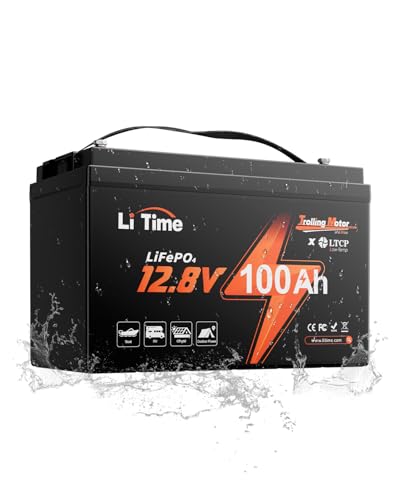
Best for: Buyers prioritizing marine-use features and lower battery weight. LiTime lists a 22.16-pound weight, a Group 31 size, and compatibility with 12V–36V motors. The listing describes extra BMS protection against dust, water, and salt spray, as well as safeguards against overcharge, overheating, and short circuits.
Cold-weather controls are another distinguishing feature: the battery stops charging below 32°F and stops discharging below -4°F, according to the product information. Choose this option if those stated temperature limits match your expected boating conditions.
Limitation: The cold-weather cutoffs restrict charging and discharging at low temperatures. Check your boat’s battery space and system requirements before selecting a Group 31 battery.
Mighty Max 12V 55Ah Deep-Cycle Battery

Best for: Trolling-motor owners looking for a sealed 12V battery with more stated capacity than a 35Ah model, but who do not need a 100Ah battery. Mighty Max identifies this as a maintenance-free sealed lead-acid battery with AGM, spill-proof construction.
The listed dimensions are 9.06 by 5.43 by 8.98 inches. The manufacturer also cites a high discharge rate, a wide operating-temperature range, and deep-discharge recovery. This battery is selected as a straightforward mid-capacity lead-acid alternative.
Limitation: The listing includes the battery and screws only; it does not include a wire harness or mounting accessories. Plan for any separately needed connections or mounting equipment.
Buying Guide: How To Choose A Trolling Motor Battery
How much capacity do you need?
Compare battery capacity in amp-hours (Ah) with your motor’s power draw and the time you expect to run it. A 100Ah model has a higher stated capacity than a 50Ah or 55Ah model, but actual runtime depends on load, operating conditions, and usable battery capacity. Check the motor manufacturer’s voltage and battery recommendations.
Should you choose AGM or LiFePO4?
AGM and sealed lead-acid options provide a familiar sealed format, while the listed LiFePO4 batteries emphasize lower weight and integrated BMS protections. Compare weight, capacity, charging requirements, and total system fit. Do not assume every charger works with both chemistries.
Will it fit your boat?
Measure the battery compartment and check terminal type, cable reach, and mounting needs. Group size can help with fit, but verify the exact product dimensions. Also consider how much weight you can carry and where the battery will be installed.
What protections matter on the water?
Review the battery’s stated protection features, temperature limits, and intended use. A BMS may manage electrical and temperature conditions, but it does not replace correct wiring, charging, or secure installation. Distinguish deep-cycle batteries from engine-starting batteries; some listed lithium models explicitly exclude cranking use.
Frequently Asked Questions
Can I use a car battery for a trolling motor?
A deep-cycle marine battery is generally the more relevant choice for sustained trolling-motor use. Check the motor maker’s battery recommendations rather than assuming a car starting battery is suitable.
Is a 100Ah battery always better?
No. A 100Ah battery has a higher rated capacity than a 50Ah battery, but it may be heavier, larger, or more capacity than your setup needs. Match the battery to motor draw, trip length, and available space.
Can a lithium battery start a boat engine?
Not necessarily. The SUPER EMPOWER and Lithova listings specify that their batteries are for energy storage and are not suitable for engine starting. Check the intended use of any battery before relying on it for cranking.
Do I need to buy wiring or mounting parts separately?
Check what each listing includes. The Mighty Max 55Ah listing says it includes the battery and screws but no wire harness or mounting accessories.