Choosing the right deep cycle battery involves evaluating chemistry, capacity, safety, and installability. This guide highlights five top options that balance performance, durability, and value for American households, campers, boaters, and outdoor enthusiasts. Whether you’re powering an off-grid cabin, an RV rig, a trolling motor, or a solar setup, these models represent strong all-around choices. A quick at-a-glance table of the selected products follows the introduction to help you compare at a glance.
| Brand | Model | Chemistry | Capacity (Ah) | Notable Feature |
|---|---|---|---|---|
| WEIZE | Weize Deep Cycle AGM 12V 100Ah | AGM | 100 | Low self-discharge, maintenance-free |
| Renogy | Renogy Deep Cycle AGM 12V 100Ah | AGM | 100 | Safe, scalable; up to 4P in parallel |
| OPTIMA | Optima BlueTop D34M | AGM | 55 | SpirALCELL tech; dual terminals |
| Interstate | Interstate DCM0100 | AGM | 110 | Spill-proof; universal fit |
| Rvpozwer | Rvpozwer 12V 100Ah LiFePO4 | LiFePO4 | 100 | Long lifespan; built-in smart BMS |
Weize 12V 100Ah AGM Battery
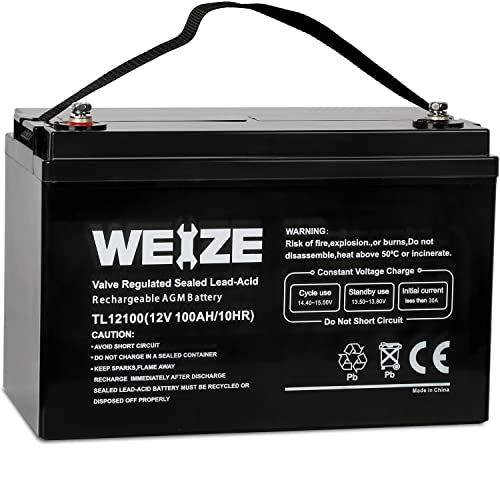
The Weize 12V 100Ah AGM deep cycle battery is designed for maintenance-free operation in exposed environments such as RVs, solar systems, trolling motors, and off-grid cabins. Its AGM construction helps prevent acid leakage and allows installation in a variety of orientations. The unit’s compact dimensions (approximately 13 x 7 x 8 inches on a standard LxWxH basis) make it a flexible choice for tight compartments or vehicle storage bays. It supports higher surge discharges, making it capable of handling peak power draws when motors or inverters start up.
- Maintenance-free AGM design reduces upkeep and spills.
- Low self-discharge rate improves storage readiness (1–3% per month).
- High discharge capability (up to about 1150A for short bursts).
- Wide operating temperature range supports diverse climates and charging conditions.
Users can expect reliable deep cycling performance across RV, solar, and marine applications, with a balance of durability and practical price point. Proper care—keeping it charged and within recommended temperatures—helps maximize the lifespan of this sealed lead-acid option.
Renogy 12V 100Ah AGM Battery

Renogy’s Deep Cycle AGM battery is a trusted option for long-term off-grid power with a focus on safety and reliability. The AGM design minimizes maintenance and internal corrosion while offering robust charge acceptance suitable for RVs, cabins, trolling motors, and marine systems. Renogy emphasizes scalable configurations, with no practical limit on series connections and support for up to four in parallel, which is especially useful for expanding capacity as needs grow. The battery’s sealed construction keeps it safe in enclosed spaces, reducing breathing requirements and maintenance concerns.
- Approved AGM chemistry with sealed, spill-resistant design.
- Series and parallel compatibility (up to 4P) for scalable capacity.
- Extensive deployments with a reputation for reliability (hundreds of thousands of units sold).
- Low maintenance with straightforward installation and connections.
For users prioritizing longevity and modular expansion, Renogy’s 100Ah AGM balances solid capacity with practical installation flexibility, suitable for a range of off-grid and vehicle-based power setups.
Optima BlueTop D34M AGM Battery

Optima’s BlueTop D34M is a compact, high-performance AGM battery designed for dual purpose use—providing strong starting power and steady deep-cycle capability for marine and RV systems. Although its capacity is lower at 55Ah, it compensates with 750 CCA and a reserve capacity of around 120 minutes, making it a dependable choice for starting loads in conjunction with auxiliary deep-cycle packs. The Dual SAE & 5/16″ stainless steel posts provide flexible mounting and wiring options, while SpiralCell technology delivers high power output with reduced plate shedding and longer life in demanding weather.
- 12-volt, 750 CCA and 55Ah capacity for reliable starting power.
- SpiralCell technology for increased performance and longevity.
- Dual terminal posts enable versatile mounting and connections.
- Maintenance-free, sealed AGM design suitable for wet or dry environments.
Optima’s BlueTop line is well-suited for boaters and RV enthusiasts who need dependable starting power plus solid deep-cycle capability in a compact footprint.
Interstate DCM0100 12V 110Ah AGM

The Interstate DCM0100 is a robust deep-cycle battery designed for demanding RV, solar, wind, and off-grid applications. It emphasizes maintenance-free operation with AGM technology and a marine-grade seal to reduce leakage and spills. This 12V 110Ah battery comes with an insert terminal configuration thatSome installers will appreciate for specific mounting trays and wiring layouts. It’s built to deliver reliable discharge profiles for extended cycling, making it a practical choice for larger energy storage needs where space allows.
- Deep-cycle AGM design with spill-proof construction.
- 110Ah capacity supports longer run times between charges.
- Universal insert terminals accommodate a range of mounting options.
- Rugged construction for RVs, boats, and off-grid systems.
Interstate’s DCM0100 provides a balance of capacity, safety, and compatibility with standard power setups, appealing to users who need a sturdy, easy-to-install option for everyday deep-cycle use.
Rvpozwer 12V 100Ah LiFePO4 Battery

The Rvpozwer LiFePO4 battery represents a modern leap in deep-cycle power with a 12.8V nominal chemistry and a stated 100Ah capacity. LiFePO4 cells deliver a dramatic increase in cycle life, with about 4000 cycles at 100% DoD, 6000 cycles at 80% DoD, and up to 15000 cycles at 60% DoD. A built-in 120A BMS provides protections against overcharge, over-discharge, over-current, over-voltage, short circuits, and temperature extremes. The unit is designed for compatibility with Group 31 standards and can be expanded by connecting multiple cells in series or parallel, enabling scalable off-grid power for RVs, trolling motors, solar arrays, and marine use, all while maintaining a lighter weight than traditional lead-acid options.
- Long cycle life: thousands of cycles depending on depth of discharge (DOD).
- Smart 120A BMS protects against common electrical faults.
- Expandable and scalable with Series/Parallel configurations (up to 51.2V).
- Group 31 size compatibility suitable for RV and marine trays.
For users prioritizing longevity, safety, and modular expansion, LiFePO4 batteries like this model offer compelling advantages despite a higher upfront cost compared with AGM options.
Buying Guide
Chemistry And Longevity
Two major deep-cycle chemistries dominate today: AGM lead-acid and LiFePO4 lithium iron phosphate. AGM models excel in lower upfront cost, straightforward charging, and proven performance in a wide range of temps. LiFePO4 cells offer significantly longer lifespans, better cycle stability, faster charging in some setups, and superior safety due to stable chemical reactions. When longevity and total cost of ownership matter, LiFePO4 often wins, but AGM remains a solid choice for budget-conscious users or simpler systems.
Capacity, Size And Weight
Capacity (Ah) indicates how long a battery can supply power before recharging. Higher Ah means longer run time, but weight and size also matter for installation. LiFePO4 packs typically deliver similar or higher usable capacity at much lower weight than lead-acid, improving efficiency in mobile setups. Always verify tray dimensions and mounting clearance before purchasing.
Safety, Maintenance, And Charging
AGM batteries are maintenance-free and sealed, reducing acid-spill risk but requiring proper venting in some configurations. LiFePO4 packs come with advanced BMS protections to prevent damage from overcharging or short circuits. A good charging strategy should match the battery’s chemistry, using a charger compatible with the battery type and following manufacturer recommendations for temperature compensation and resting voltages.
Installation And Compatibility
Consider terminal types (insert terminals versus post terminals), mounting orientation, and space constraints. Some models support flexible mounting, while others are limited by terminal arrangements. Ensure compatibility with your inverter/charger, solar charge controller, and any series/parallel configurations you expect to use. Group size compatibility (for example, Group 24 or Group 31 trays) can influence fit and replacement ease in vehicles or boats.
Budget, Value, And Availability
Upfront cost often drives choice. AGM options provide reliable performance at a lower initial price, while LiFePO4 options deliver longer life and better cycle stability—yielding greater long-term value in programs with frequent cycling. Availability and warranty terms also shape value; consider how long you plan to own the system and whether a vendor offers robust after-sales support and replacement policies.
In summary, the best deep-cycle battery for you depends on how you balance upfront cost, cycle life, weight, and installation constraints. AGM models like Weize, Renogy, Optima, and Interstate offer proven reliability and simpler handling, while LiFePO4 options such as Rvpozwer provide superior longevity and expansion potential for long-term off-grid and mobile power needs. Assess your load, climate, and charging infrastructure to select the most suitable option.