Answering the need for fast, reliable vehicle diagnostics, these car fault code readers help identify engine light causes and provide actionable data for DIYers and budget-conscious drivers. The top picks below are best suited for occasional at-home diagnostics, pre-purchase checks, and straightforward repairs on most 1996+ OBDII vehicles.
The following table highlights the five selected models, what they’re best for, and the key strengths you’ll want to consider when choosing.
| Product | Best For | Key Benefit |
|---|---|---|
| ANCEL AD310 | Beginners and quick checks | Fast readings, clear live data, compact design |
| ANCEL AD410 | DIYers wanting broader diagnostics | Comprehensive OBDII functions and 42,000+ DTC lookups |
| FOXWELL NT301 | Accurate code reading and emissions readiness | One‑click CEL reset and I/M readiness indicators |
| VDIAGTOOL VD10 | Cost-conscious beginners with wide code support | Over 3,000 DTC definitions and clear data readouts |
| MOTOPOWER MP69033 | Multi‑brand vehicles with broad protocol support | 9 protocols, live data, and robust display |
ANCEL AD310 Classic Enhanced OBD II Scanner

The ANCEL AD310 is a compact, budget‑friendly OBDII scanner designed for quick trouble‑code reading and clearing. It supports 1996+ vehicles and provides live data, freeze frame, I/M readiness, and vehicle information. This model is well suited for first‑time users who want a reliable, no‑frills diagnostic tool that plugs into the OBDII port and powers from the vehicle. It’s best for drivers who want immediate feedback on engine lights without complex features.
Who it’s best for: DIYers seeking a straightforward, portable diagnostic tool to identify the cause of check engine lights and verify repairs quickly. It’s also useful for shoppers who need a dependable entry‑level scanner that won’t overwhelm with advanced customization.
Caution: The AD310’s feature set is intentionally limited to core OBDII functions. If you need extensive parameter data or professional‑level graphing, consider a more feature‑rich model.
ANCEL AD410 Enhanced OBD2 Scanner

The AD410 extends beyond basic code reading with a broader OBDII diagnostic scope. It provides reading/clearing codes, live data, freeze frame, I/M readiness, O2 sensor tests, EVAP tests, and vehicle information. With 42,000+ built‑in DTC lookups, it helps users interpret fault codes and communicate with mechanics more confidently. Real‑time data helps diagnose patterns and verify repairs after work.
Who it’s best for: DIYers who want a more capable tool for ongoing maintenance, especially those who value rapid access to code definitions and a wider set of tests before visiting a shop.
Caution: While feature-rich, it may still lack some advanced OEM‑specific capabilities for certain brands. Confirm compatibility for your vehicle if it’s a newer or less common model.
FOXWELL NT301 OBD2 Scanner

The FOXWELL NT301 focuses on quick, professional‑level diagnostics in a compact unit. It can read and clear engine fault codes, display live data, and provide one‑click I/M readiness testing. The device supports a clear user interface with a dedicated status LED and built‑in speaker for audio feedback, helping you determine if your vehicle is ready for emissions testing. This model is ideal for those who want a dependable tool with straightforward operation.
Who it’s best for: DIYers who want fast results, reliable readouts, and a clear indication of emissions readiness before inspections. It’s also a solid choice for owners who prefer a simple one‑button workflow for the most common checks.
Caution: NT301 emphasizes ease of use over deep, manufacturer‑specific diagnostics. For complex, brand‑specific codes, you may need a higher‑end scanner.
VDIAGTOOL VD10 OBD2 Scanner
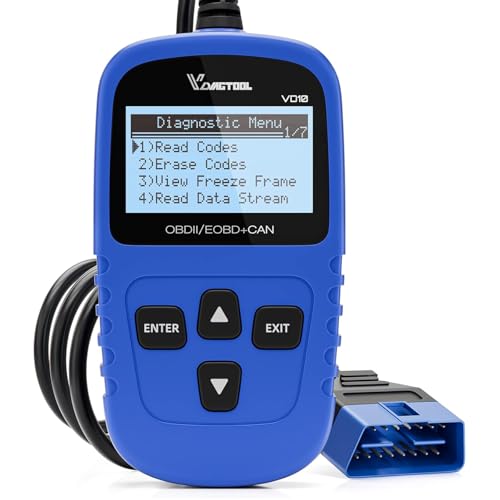
The VD10 is designed as a practical tool for DIYers, offering code reading/clearing, live data, freeze frame, I/M readiness, and vehicle information. It pulls data from a substantial built‑in database (over 3,000 codes) and presents DTC definitions on the TFT display. The device is easy to use, requires no external power, and delivers fast fault code retrieval.
Who it’s best for: Beginners who want a simple, reliable interface with a broad code database, helping identify root causes quickly. It’s also suitable for those who need quick definitions to discuss repairs with a mechanic.
Caution: Data depth is solid for many vehicles, but some newer or highly specialized models may require more advanced scanning capabilities not offered by this unit.
MOTOPOWER MP69033 OBD2 Scanner

The MP69033 is a versatile OBDII scanner that supports up to nine protocols, making it compatible with many US‑, EU‑, and Asian‑market vehicles. It features a large 2.8″ LCD display, supports read/erase codes, live data, data flow, and vehicle information. Its plug‑and‑play operation draws power directly from the vehicle via the OBDII port, which helps keep the device simple and ready to use on the go.
Who it’s best for: Drivers with a mixed fleet or those who frequently troubleshoot different brands will benefit from the broad protocol support. It’s also a good choice for users who prefer a bright, readable display for on‑the‑spot diagnostics.
Caution: The MP69033’s broad compatibility means it may lack some higher‑end OEM features found in professional scanners. For advanced diagnostics, consider a model with more nuanced parameter controls.
Buying Guide
What should you prioritize in a car fault code reader?
- Vehicle compatibility: Ensure it supports your year, make, and model (OBDII is standard for 1996+ in the US).
- Code library depth: A larger DTC database helps interpret errors clearly and suggest likely root causes.
- Live data and freeze frame: Real‑time parameter monitoring aids diagnosis beyond just the code.
- I/M readiness and emissions tests: Useful for pre‑inspection checks before state tests.
- Ease of use: For first‑timers, a straightforward interface with clear instructions matters more than advanced features.
- Power source: Most tools rely on the vehicle’s power via the OBDII port; battery‑less operation reduces clutter.
Which features matter most for different buyers?
- Casual driver or new DIYer: Look for an affordable model with basic reading/clearing and live data (AD310, VD10).
- Regular DIYer or pre‑purchase checker: A broader feature set, including live data graphs and I/M readiness (AD410, NT301).
- Fleet or multi‑brand use: A scanner with wide protocol support and multi‑vehicle compatibility (MP69033) is advantageous.
How to use a car fault code reader effectively
- Plug into the OBDII port with the ignition off, then turn the ignition on (some devices power from the port automatically).
- Read codes first, then clear only after the underlying issue is fixed to avoid a false‑pass scenario.
- Use live data to spot abnormal engine patterns; save or print data for reference when visiting a shop.
Maintenance tips for your reader
- Keep the device clean and dry when used in the engine bay.
- Avoid tucking the unit into hot areas; store in a protective case when not in use.
- Check for firmware updates if the manufacturer provides them to maintain compatibility with newer vehicles.
FAQ
- Q: Do these readers work on diesel engines? A: Many OBDII readers support both gasoline and diesel engines that comply with OBDII; verify compatibility for your specific vehicle.
- Q: Can I reset the check engine light with these devices? A: Some models offer code clearing and CEL reset after issues are repaired; others may only read codes. Check the product details before purchase.
- Q: Will these tools diagnose every OEM issue? A: They provide root‑cause indicators and data, but highly complex or manufacturer‑specific problems may require dealer diagnostics.
- Q: Do I need a professional warranty or subscription? A: Most consumer OBDII scanners offer local, offline functionality without ongoing subscriptions; some models may have optional app features.
- Q: Are there safety considerations when using these scanners? A: Use the scanner with the vehicle engine off or in a safe, stationary position; follow the user manual for proper operation.
- Q: Can I use these readers on a used car before buying it? A: Yes—pre‑purchase inspections are a common use case for read/clear and freeze frame data to assess potential issues.