When selecting a backup camera system for a box truck, reliability, power options, and night vision matter most. This guide highlights five top options that balance durability, ease of installation, and actionable viewing. Best for professional operators, these selections minimize blind spots and improve maneuvering in tight spaces. The following table compares the featured models at a glance to help you decide quickly.
| Product | Best For | Power / Installation | Key Benefit |
|---|---|---|---|
| Yakry RV Backup Camera Plug and Play | Direct-shipper vans and RVs needing quick installs | Wired, 66ft cable, 8-minute install | Stable signal, true night vision |
| 1080P HD Wireless Backup Camera – Pemacom | Vehicles where wiring is difficult | Wireless, up to 33 ft, 2.4GHz | High clarity in daylight and low light |
| Dual RV Backup Camera for Truck – Yakry | Wide coverage with dual perspectives | Plug-and-play, 30-minute install | Split-screen view improves safety |
| Backup Camera for Trucks – VECLESUS | Large vehicles needing long extension cords | 66ft cord, multiple channels | Two-channel viewing and long reach |
| Truck Backup Camera Monitor Kit – DALLUX | Rugged, all-weather use | IP69K waterproof camera, 7″ monitor | Night vision up to 50ft, robust build |
Yakry RV Backup Camera Plug and Play

The Yakry wired backup system is a 7″ HD 1080P setup that uses a single power source to run both camera and monitor. Its 66ft cable keeps wiring tidy and reduces delay, making it suitable for box trucks that require a straightforward install. The camera offers true IR night vision and a wide 150-degree field of view with minimal distortion. Best for fleet operators or drivers who want a reliable, plug-and-play wired option with stable signal. Caution: because this is a wired system, planning cable routing is essential to avoid pinch points during installation.
1080P HD Wireless Backup Camera – Pemacom

This Pemacom wireless system delivers 1080P color video with a magnetic base that installs in a minute. It uses 2.4GHz transmission and features signal-hopping technology for improved stability, ideal for box trucks where wiring is impractical or prohibited. Best for drivers who want a fast retrofit with minimal vehicle modification. Caution: wireless interference can occur in environments with dense RF activity, so consider a backup plan if you operate near strong signals.
Dual RV Backup Camera for Truck – Yakry
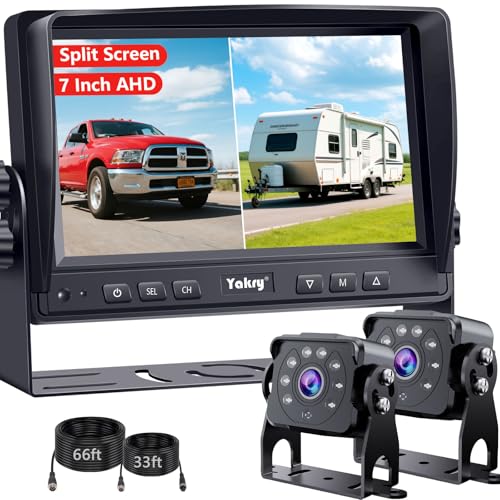
Yakry’s dual-camera system provides split-screen viewing, letting drivers monitor rear and front or hitch areas simultaneously. It’s a plug-and-play setup tailored for box trucks that require comprehensive coverage, especially when backing into tight spaces or aligning trailers. Best for operators who want enhanced situational awareness. Caution: the primary display is 7″ and may require mounting space with a clear line of sight for optimal visibility.
Backup Camera for Trucks – VECLESUS

VECLESUS offers a 7″ LCD monitor with two-channel input and a 66ft extension cord, designed for larger vehicles like box trucks or vans. It supports 9–36V operation and provides automatic ON/OFF based on the vehicle’s reverse gear. Best for operators who need a flexible two-camera setup and long-range wiring. Limitation: some users may require additional front camera compatibility for full coverage.
Truck Backup Camera Monitor Kit – DALLUX

DALLUX pairs a rugged 7″ monitor with IP69K waterproof camera, ideal for heavy-duty box trucks operating in harsh weather. Night vision is strong, aided by infrared lights that reach up to 50 feet in total darkness. Best for fleets that work in challenging environments. Caution: the camera and monitor are rated for waterproof use, but proper sealing during installation remains important to maintain water resistance over time.
Buying Guide
What should you consider when choosing a backup camera for a box truck?
Power availability is essential. Wired systems avoid interference but require routing; wireless systems simplify installation but can face signal interference. Consider the power source: ACC-powered, reverse-gear triggered, or constant power depending on whether you want the display to turn on with the vehicle or only when backing up.
How many cameras do you need?
Single-camera setups are common and cost-effective. If you regularly back into tight spaces or hitch trailers, a dual-camera system with split-screen (rear plus front or hitch) can significantly improve safety.
What about screen size and visibility?
For box trucks, a 7″ to 9″ display is typical. A larger screen improves detail recognition, especially at night or in bright sunlight. Anti-glare and infrared night vision are valuable features for low-light conditions.
Wired vs wireless—what’s better for a box truck?
Wired kits provide stable signal with no interference, ideal for busy work sites. Wireless kits are easier to install but can suffer from interference or distortion in dense RF environments. Choose based on installation feasibility and operating conditions.
Durability and weatherproofing
Look for IP69K-rated cameras for all-weather reliability. Heavy-duty construction matters for fleets exposed to dust, rain, snow, or vibration.
Installation considerations
Assess vehicle architecture: door sill clearance, spare wiring paths, and dash space for mounting. Some kits come with dashed diagrams and brackets to simplify mounting inside cabs or on dashboards. Consider professional installation if wiring under dashboards or through vehicle panels is required.
FAQ
1. Do wired systems perform better than wireless for box trucks? Yes, wired systems generally offer more stable signals with no latency or interference, making them reliable for frequent backing and heavy use.
2. Is 66ft of cable enough for most box trucks? Yes, 66ft covers typical rear clearance needs and allows some routing flexibility around wheels and frames.
3. Can I install these myself? Many kits are designed for DIY installation with plug-and-play wiring or simple mounting brackets, but some installations may require professional help for routing and dash mounting.
4. Will these cameras work in complete darkness? Most have infrared night vision that helps identify objects in low light down to about 50 feet depending on the model.
5. Are dual-camera setups worth it for a box truck? Dual-camera systems provide separate rear and hitch/front views, reducing blind spots and aiding in trailer hitching or lane changes.
6. Do these cameras support wide voltage vehicles? Several models support broad input voltage ranges (often 9–36V), which is suitable for various heavy-duty vehicles including box trucks.