Choosing the right amplifier can dramatically improve the clarity and impact of your car’s sound system. This guide highlights five versatile amplifiers that balance power, efficiency, and installability for common speaker setups. Whether you’re upgrading factory speakers or building a multi-channel system with a dedicated sub, these models offer solid performance, reliable protection features, and flexible input options. Use the summary table to compare core specs at a glance, then dive into detailed overviews to help pick the best match for your ride.
| Product | Brand | Channels | Max / RMS (approx) | Notes |
|---|---|---|---|---|
| BOSS R1004 Riot Series 4 Channel | BOSS Audio Systems | 4 | 100W x4 @2Ω; 50W x4 @4Ω (max ratings) | Class A/B, high/low inputs |
| Taramp’s TS 400×4 Black | Taramp’s | 4 | 400W RMS @2Ω; 200W x2 @4Ω | RCA input; high-level input; automatic activation |
| Taramp’s TS 1200×4 | Taramp’s | 4 | 1200W RMS total; ~300W RMS per channel @2Ω | High-level input; automatic activation; fixed crossovers |
| DS18 SXE-1200.4/RD | DS18 | 4 | 60W RMS per channel @4Ω; 240W total | Fully variable crossover; compact Class A/B |
| STINGER MT-1000.5 | STINGER | 5 | 1200W RMS total | Class D; remote sub control; HEXFET MOSFET |
BOSS R1004 Riot 4-Channel Amplifier
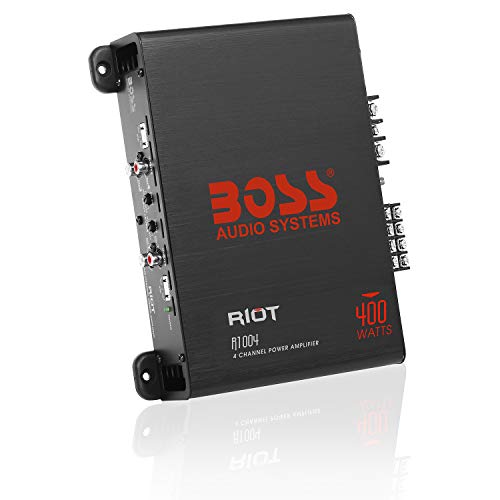
The BOSS R1004 Riot Series delivers four-channel power in a compact, entry-to-mid level package. Its Class A/B topology supports substantial current flow for dynamic transients, while the 2–8 ohm stability helps accommodate a wide range of speaker loads. It provides both low-level RCA inputs and high-level connections, enabling easy integration with factory head units or aftermarket radios. Rated outputs are listed as up to 100W per channel at 2Ω and 50W per channel at 4Ω, making it suitable for upgrading a standard four-speaker setup. The unit’s practical size simplifies dashboard mounting, and the full-range outputs offer broad compatibility with popular speaker configurations.
Installation considerations include ensuring proper heat dissipation and a clean grounding path. Because this model supports multiple input types, it’s versatile for diverse car audio projects, from simple two-way upgrades to full-range four-speaker systems. The Riot line is known for dependable operation under typical driving conditions, with basic protection features to guard against common faults. For budget-conscious users seeking noticeable improvements without complex configurations, the R1004 provides a balanced, straightforward option.
Taramp’s TS 400×4 Black 400W 4-Channel

The Taramp’s TS 400×4 is a robust multichannel amplifier designed to drive four full-range speakers with ample headroom. It delivers 400W RMS at 2Ω, with the option to bridge two channels for higher power at 4Ω (200W per bridged pair). The inclusion of both RCA inputs and high-level inputs with automatic activation makes it compatible with various head units, including factory radios. Class D design concentrates power efficiency, reducing heat buildup in compact dashboards while maintaining strong, clean output across four channels. This model suits mid-range upgrades or custom builds needing reliable multi-channel performance.
Practical installation notes include planning adequate venting and securing the amp away from heat sources. The TS 400×4’s high-level input and automatic activation simplify integration with cars that lack line-level outputs. It’s well-suited for four-speaker systems where a clean, efficient signal chain and stable performance at 2Ω are priorities. For enthusiasts aiming to push a bit more bass or clarity through each door or rear speaker, this amp provides a solid balance of power and features without excessive complexity.
Taramp’s TS 1200×4 4-Channel Amplifier

The Taramp’s TS 1200×4 brings a high-output, four-channel solution with 1200W RMS total power. It distributes about 300W RMS per channel at 2Ω, making it a strong candidate for premium four-speaker systems and even light subwoofer tasks when wired appropriately. High-level inputs and automatic activation add flexibility for integrating with various head units. Fixed crossovers provide reliable tone shaping across the full spectrum, enabling precise control over high-pass and full-range responses. This amp is designed for users who want more headroom without sacrificing channel count.
With 4-channel versatility and a focus on strong efficiency in Class D topology, the TS 1200×4 suits installations that require clear highs and solid mids across four channels. The built-in activation logic simplifies startup behavior, while the device’s robust construction supports longer listening sessions with minimal thermal stress. If you’re selecting a four-channel powerhouse that can grow with your system, the TS 1200×4 offers compelling value and performance.
DS18 SXE-1200.4/RD Four-Channel Amplifier

The DS18 SXE-1200.4/RD is a four-channel Class A/B amplifier built for strong musical performance in car environments. It delivers 60W RMS per channel at 4Ω, with a total of about 240W RMS, which is ample for four decent-sounding speakers without overtaxing the electrical system. A fully variable crossover, adjustable gain, and a multi-channel architecture give installers precise control over the tonal balance and loudness across the entire system. Its compact size helps with tight dashboards and custom enclosures, while the robust power design supports reliable operation under continuous use.
For installations that require tailored speaker response, the SXE-1200.4/RD’s adjustable crossover and straightforward wiring are appealing. The combination of Class A/B operation with modern efficiency features offers a balanced approach to performance and heat management. If you want a four-channel platform that prioritizes sound tuning and install flexibility, this DS18 model is a strong choice for a varied range of car audio builds.
STINGER MT-1000.5 Five-Channel Amplifier

The STINGER MT-1000.5 stands out as a five-channel platform, delivering a total of 1200W RMS across all channels. Built on a digital Class D design with HEXFET MOSFET power, it emphasizes efficiency and compact size. A remote subwoofer bass knob provides convenient tone shaping from the driver’s seat, while separate high-pass and low-pass filtering options help tailor fronts, rear fills, and subwoofers to the vehicle’s acoustics. The MT-1000.5 also includes protected circuits to guard against short circuits and overloads, which contributes to reliable performance in varied installation conditions.
Five channels offer a straightforward path to a full-range front and rear setup plus a dedicated sub, reducing the need for additional amplifiers. This model is well-suited for installers seeking solid power with a compact footprint and convenient remote control for bass management. For users prioritizing efficiency, space, and flexible crossover options, the MT-1000.5 provides a compelling blend of features and performance in one versatile package.
Buying Guide
Key considerations when choosing a car amplifier for speakers:
- Power and impedance: Match RMS power to your speaker’s rated handling and ensure the amp is stable at your speaker impedance (commonly 2–8 ohms). Higher channel counts allow more speakers without overloading a single channel.
- Channel count and usage: Four-channel amps are ideal for powering four speakers; five-channel units add a dedicated sub channel, simplifying wiring for a sub and stereo fronts/rears.
- Inputs and compatibility: Look for RCA inputs for aftermarket head units and high-level inputs for factory radios. Automatic activation (remote turn-on) helps when a remote signal isn’t readily available.
- Class design and efficiency: Class D offers high efficiency and compact form factors ideal for vehicles; Class A/B provides robust linear power but can run hotter and larger. Choose based on space and heat considerations.
- Crossover controls: Fixed vs adjustable crossovers determine how you shape the frequency range sent to each speaker. Fully adjustable crossovers give the most tuning flexibility for custom installs.
- Size, mounting, and cooling: Ensure the amp fits your dash, trunk, or under-seat cavity and has adequate ventilation. Heat management is critical in enclosed spaces.
- Protection features: Look for thermal protection, short-circuit protection, and overcurrent safeguards to protect both the amplifier and your speakers during demanding listening sessions.
- Remote bass control: A remote knob can simplify bass tuning from the seat, especially when the sub is placed in a different location from the amp.
- Installation considerations: Plan wiring gauge, fuse sizing, grounding, and routing to minimize noise and interference. A clean install improves both performance and reliability.
- System goals: For a balanced setup, decide whether you prioritize loudness, detail, or bass impact. Your choice should align with your vehicle’s acoustics and listening preferences.
These models cover a spectrum of common car audio goals—from straightforward four-speaker upgrades to more elaborate five-channel configurations that integrate a sub and full-range channels. When selecting, consider how much space you have for mounting, your desired level of tuning control, and how the amp’s efficiency will interact with your vehicle’s electrical system. A well-chosen amplifier can unlock clearer highs, stronger mids, and deeper bass without compromising reliability or install practicality.