Answering the question “which 2 1/2 inch hitch should I buy for a 2.5″ receiver?” this guide highlights five dependable options that accommodate dual ball sizes (2″ and 2-5/16″), feature adjustable rise/drop, and support heavy towing. Best for trucks, RVs, campers, and utility trailers, these hitches are chosen for compatibility with 2.5″ receivers and versatile towing needs. Use the buyer’s table below as a quick reference, then read detailed sections to understand who each product is best for and why.
| Product | Best For | Towing Capacity | Notes |
|---|---|---|---|
| CAMMOO Adjustable Trailer Hitch | Heavy-duty trucks and RVs needing 6″ rise/drop | 22,000 lbs GTW | Dual 2″ and 2-5/16″ balls |
| METOWARE Adjustable Trailer Hitch | Versatile setups; frequent height adjustments | 18,000 lbs GTW | 6″ drop/6″ rise; dual balls |
| Koerdo Adjustable Trailer Hitch | Farmers and tough-tow applications | 22,000 lbs GTW | Solid bar stock; dual balls |
| B&W Tow & Stow Adjustable Ball Mount (TS20037B) | Urban garages; storage-friendly towing | 18,000 lbs GTW | Stows under vehicle; anti-theft |
| CURT 45371 Forged Trailer Hitch Mount | High-capacity, straightforward installs | 20,000 lbs GTW | 2-5/16″ ball; 2-1/2″ receiver |
CAMMOO Adjustable Trailer Hitch, 2.5″ Receiver

This hitch is designed for universal 2.5” receivers and features a 6″ rise or drop, plus dual ball sizes (2″ and 2-5/16″). It targets heavy-duty towing tasks across trucks, RVs, campers, and off-road trailers. The anti-theft pin adds a security layer when parked or left unattended. Best for buyers who need a single, adaptable solution that covers multiple coupler sizes and height adjustments.
Best for: Truck owners and campers who frequently deal with height mismatches between vehicle and trailer. Why: the 6″ adjustment with incremental 1″ steps makes level towing easier on uneven terrain. Caution: verify outer width and inner receiver size before purchase to ensure compatibility with your setup.
METOWARE Adjustable Trailer Hitch
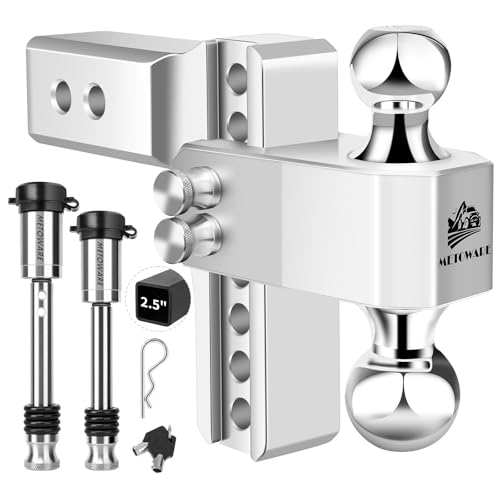
The METOWARE hitch supports 2.5″ receivers and offers a 6″ drop and 6″ rise, enabling precise alignment for various trailer heights. It switches between 2″ and 2-5/16″ hitch balls to accommodate common trailer couplers. Built with dual stainless steel locks and a robust design, it emphasizes durability for repeated heavy use. Best for: Buyers who need easy, frequent height changes and a reliable dual-ball system. Why: the 6″ adjustment range helps maintain level towing across a wide range of vehicles.
Limitation: assembly and alignment may require careful setup; check your trailer’s coupler size and receiver width before committing.
Koerdo Adjustable Trailer Hitch

The Koerdo model fits 2.5″ receivers and features dual balls for 2″ and 2-5/16″ couplers, with a 6″ drop and 6″ rise for flexible setup. It’s described as a solid, high-quality iron alloy hitch with corrosion-resistant coating, designed for heavy-duty towing. Best for: Those who value a heavy-duty build and long-term durability. Why: solid bar stock construction tends to resist wear and deformation under load. Caution: data notes emphasize fit compatibility; ensure your trailer coupler matches the dual-ball system.
B&W Tow & Stow Adjustable Ball Mount (TS20037B)

The B&W Tow & Stow system offers adjustable height for level towing and a stowable design that tucks away under the vehicle when not in use. It comes with dual ball sizes and an anti-theft feature to secure the assembly in the receiver. Best for: Urban users who want a compact, secure solution with easy stowaway storage. Why: the stow-and-go design reduces risk of bumping shins and garage doors. Caution: ensure you have space under your vehicle for the stowed position and that the anti-theft mechanism remains compatible with your receiver.
CURT 45371 Forged Trailer Hitch Mount

The CURT 45371 is a forged hitch mount with a 2-5/16″ ball for 2.5″ receivers, rated for up to 20,000 lbs gross trailer weight and 2,000 lbs tongue weight. It provides a reliable, straightforward option with a fixed 2-1/2″ receiver size and a dedicated ball. Best for: Buyers who want a robust, simple-to-install solution without dual-ball versatility. Why: forged steel construction offers strong, consistent performance for high-load towing. Caution: fixed ball configuration means less adaptability if you frequently switch trailer sizes.
Buying Guide: Key Purchase Considerations
- Receiver compatibility: Confirm 2.5″ receiver compatibility and ensure the outer width of your receiver can accommodate the lock pin length and any added hardware.
- Dual balls vs. single ball: If you tow trailers with different coupler sizes (2″ and 2-5/16″), a dual-ball system is advantageous. If you mostly tow one size, a single-ball option may be simpler and lighter.
- Rise and drop range: A wide rise/drop range (like 6″ up and down) simplifies leveling across a variety of trailers and vehicle heights.
- Material and durability: Solid bar stock and forged construction typically offer better durability under heavy loads; check corrosion resistance and coating
- Security: Anti-theft pins and locking mechanisms add protection when the hitch is left unattended.
- Stowability: Some models are designed to tuck under the vehicle after use; this is helpful in tight garages or for avoiding injuries from protruding hardware.
How To Choose: Quick Decision Guide
- Need dual-ball support and maximum height adjustment? Consider CAMMOO, METOWARE, or Koerdo for versatility and higher capacities.
- Prefer a compact, secure setup with easy storage when not towing? Look at B&W Tow & Stow options.
- Want a straightforward, high-capacity option with minimal adjustment? CURT 45371 provides strong performance with a fixed ball size.
Frequently Asked Questions
- What does GTW mean and why does it matter?
Gross Trailer Weight (GTW) is the total weight a trailer can safely tow, including cargo. Choose a hitch with GTW rating at or above your trailer’s gross weight. - What is the difference between 2″ and 2-5/16″ balls?
They are the two most common trailer coupler sizes. A hitch with dual balls covers both sizes, while a single-ball hitch supports only one size. - Do I need a specific rise or drop?
Yes. Determine the vertical distance between the hitch receiver and the trailer coupler when the trailer is level. A 6″ rise/drop range gives flexibility across many vehicles and trailers. - Is a forged hitch better than a tubular one?
Forged or solid-bar hitches generally offer higher strength and durability under heavy loads compared to hollow-tubing options. - What about anti-theft pins?
Anti-theft features deter removal of the hitch from the receiver when parked or unattended; ensure compatibility with your receiver setup. - Can I install these myself?
Most 2.5″ receiver hitches install with standard hardware; follow manufacturer instructions and use proper torque values for safety.
All five options above fit 2.5″ receivers and provide at least one dual-ball configuration or a secure, adjustable design. For buyers focusing on versatility and heavy-duty towing with variable trailer sizes, CAMMOO, METOWARE, and Koerdo are strong candidates. For urban storage and theft deterrence, B&W Tow & Stow models deliver practical convenience. CURT 45371 offers a robust forged alternative when a straightforward, high-capacity mount is preferred.