If you need reliable portable power powered by natural gas, propane, or gasoline, these tri-fuel generators offer flexibility for emergencies and outdoor work. This guide highlights five top options, explaining who each is best for and why. Ideal buyers include homeowners seeking whole‑home backup power, contractors needing run-time flexibility, and campers who want quiet operation with clean fuel choices.
Summary of chosen products:
- Westinghouse 14500 Peak Watt Tri-Fuel — Best for large homes needing strong peak power with long runtime.
- Generac 12,500 Starting Watt Tri‑Fuel — Best all‑around versatility and easy electric start.
- Westinghouse 13500 Peak Watt Tri‑Fuel — Best for higher sustained power with advanced safety features.
- DuroMax XP13000HXT Tri Fuel — Best value for full‑home capability with robust tri‑fuel options.
- Westinghouse 8200 Peak Watt Inverter Tri‑Fuel — Best for sensitive electronics and quieter operation.
Westinghouse 14500 Peak Watt Tri-Fuel Power Generator
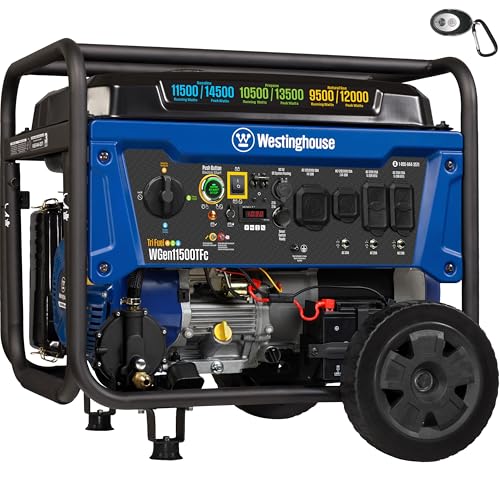
Best for: Larger homes or job sites requiring peak power and long runtime. This unit runs at 11,500 running watts on gasoline, 13,500 peak watts on propane, or 12,000 peak watts on natural gas, making it a strong choice when multiple appliances must run simultaneously. The heavy‑duty 550cc Westinghouse engine provides durability and a long service life. It can run up to 19 hours on a full 9.5‑gallon tank with a built‑in fuel gauge, and about 7 hours on a standard 20‑lb propane cylinder.
Why selected: It combines high peak output with tri‑fuel flexibility and a robust engine, suitable for homes needing substantial standby power. The remote electric start and transfer switch readiness enhance convenience during outages. A potential limitation is the size and weight, which may require a fixed area for storage and placement.
Who should avoid: If you need ultra‑quiet operation or compact size for occasional use, this model’s output may be more than necessary and its footprint larger than inverter options.
Generac 12,500 Starting Watt Tri-Fuel Generator

Best for: Home backup with easy start and fuel flexibility. Generac’s tri‑fuel design supports gasoline, propane, or natural gas. It delivers 9,500 running watts and 12,500 starting watts, with a push‑button electric start that minimizes manual effort during emergencies. It includes a 7.5‑gallon steel fuel tank that can deliver up to 9.5 hours on gasoline at 50% load, with extended runtimes when using alternative fuels.
Why selected: The electric start simplifies operation, a useful feature in stressful outages. The COsense carbon monoxide detection adds a safety edge. Caution: quietness and fuel cost vary with fuel type, and natural gas connections may require additional plumbing or adapters in some setups.
Who should avoid: If you require extremely long runtime between refuels in propane or natural gas, verify fuel availability and gas line compatibility for your location.
Westinghouse 13500 Peak Watt Tri-Fuel Generator

Best for: Home backup with substantial run time and multiple outlets. This unit delivers 13,500 peak watts and 10,500 running watts on gasoline, 12,500 peak watts and 9,500 running watts on propane, and 10,000 peak watts with 8,500 running watts on natural gas. It includes remote start with a key fob, plus a mix of outlets including transfer switch readiness, making it a solid fit for larger homes or larger appliances during outages.
Why selected: A strong balance of high peak power and multiple outlets with safety features such as a low‑oil shutdown and CO shutdown. The digital hour meter helps track maintenance. Caution: the unit is fairly large and may require careful placement for venting and access to outlets.
Who should avoid: If space is extremely tight or you prioritize inverter‑style quiet operation, this model may feel bulky compared to compact options.
DuroMax XP13000HXT Tri Fuel Portable Generator

Best for: Whole‑home power backup with flexible fuel options and built‑in safety features. The XP13000HXT delivers up to 13,000 watts and uses a robust 500cc OHV engine. Tri‑fuel capability lets you run on gasoline, propane, or natural gas, providing freedom in fuel choice when outages occur.
Why selected: It offers strong power with CO alert to help reduce fumes exposure, and a comprehensive power panel that includes transfer switch readiness for seamless integration into home backup systems. Caution: CO alerts and safety features rely on proper installation and care; verify local regulations for connecting to home panels.
Who should avoid: If you need inverter‑style clean power for sensitive electronics, consider inverter‑based options that regulate voltage more precisely during load changes.
Westinghouse 14500 Peak Watt Dual Fuel Portable Generator

Best for: Large homes requiring dual‑fuel capability with high peak output. This model mirrors other 14,500‑watt class units but emphasizes dual fuel (gasoline and propane) performance with a lengthy runtime of up to 19 hours on gasoline and around 7 hours on a 20‑lb propane tank. It has a 9.5‑gallon tank with a fuel gauge for easy monitoring.
Why selected: The dual‑fuel design provides fuel flexibility in outages or outdoor work sites. The unit includes a transfer switch ready configuration and remote electric start for convenience. Caution: while offering strong power, the unit is bulky and requires appropriate storage space and proper ventilation when operating outdoors.
Who should avoid: If you require a compact, lightweight generator for portable use, this high‑power model may not be ideal.
Buying Guide: Choosing The Right Portable Natural Gas Generator
- Fuel flexibility: If you anticipate running on natural gas, propane, or gasoline, tri‑fuel units offer the broadest options, especially during supply fluctuations or outages.
- Power needs: Determine the essential loads first (refrigerator, heating, sump pump, lights) and match peak watts and running watts accordingly. For whole‑home support, prioritize higher peak watts and longer runtime.
- Start method: Electric start simplifies operation versus pull‑start, particularly in cold weather or emergencies. Consider models with a remote start feature for added convenience.
- Safety features: Look for automatic low‑oil shutdown, CO sensors, and safe shutdown mechanisms. Also check transfer switch readiness to minimize back‑feeding risks when connecting to a home panel.
- Runtime and fuel capacity: Larger tanks extend runtime but increase weight. Compare gallons of fuel capacity and expected runtime at common loads to estimate refill needs.
- Outlets and compatibility: Ensure outlets include standard household receptacles and a transfer switch compatible plug. For RV users, check RV‑ready outlets and 30A or 50A configurations.
- Portability vs. power: Inverter generators excel at electronics safety and quiet operation but may have lower peak outputs. For heavy loads, non‑inverter tri‑fuel models offer higher wattage, at the cost of noise and fuel use.
Frequently Asked Questions
- What is a tri‑fuel generator? A tri‑fuel generator can run on gasoline, propane, or natural gas, offering flexibility during outages or when one fuel source is scarce.
- Are tri‑fuel generators louder than inverter models? Generally, traditional open‑frame tri‑fuel units are louder, but some models incorporate efficiency features to improve fuel economy and noise levels.
- Is remote electric start important for home backup? Remote start improves ease of use during outages and cold starts, reducing the need to manually start the unit.
- How do I choose the right wattage? Start by listing essential appliances and their wattage. Choose a model with enough running watts to cover those loads plus surge watts for startup.
- Do I need a transfer switch? A transfer switch simplifies safety and power management, preventing back‑feed into the utility and allowing a smooth switch to generator power for selected circuits.
- What about maintenance and safety? Follow the manufacturer’s maintenance schedule and use CO sensors, proper ventilation, and correct fueling practices to ensure safe operation.