When selecting a brake line flaring kit, the goal is precise, durable flares that prevent leaks and fit standard tubing sizes. This guide highlights five reliable options suited for different users, from hobbyists to workshop pros. Each product is evaluated for compatibility with common tubing (3/16″, 1/4″, 5/16″, 3/8″, and 1/2″ or metric equivalents), ease of use, mounting requirements, and safety considerations. The top picks emphasize clear, repeatable results and practical features for bench or vise mounting. The summary table below helps compare core specs at a glance.
| Product | Best For | Tube Sizes | Mounting | |
|---|---|---|---|---|
| SEEKSELF Professional | DIYers and enthusiasts | 3/16″, 1/4″, 5/16″, 3/8″ | Vise mounted | Includes 4 die blocks; not for under-car use |
| GEAROLL | Home garages with basic setups | 3/16″, 1/4″ | Bench vise included in kit | Not for stainless steel |
| Clatoon | Pro hobbyists and busy DIYers | 3/16″, 1/4″, 5/16″, 3/8″, 1/2″ | Portable case | Heavy-duty forged yoke |
| Fanmoss | Versatile metal tubing projects | 3/16″, 1/4″, 5/16″, 3/8″ | Bench vise or hitch vise | Wide metal compatibility |
| DPTOOL | Professional-grade at home shop | 3/16″, 1/4″, 4.75mm | Bench vise | High-quality steel construction |
SEEKSELF Professional Brake Line Flaring Tool Kit

The SEEKSELF kit is designed to produce 45-degree single, double, and bubble flares on stainless steel, steel, and some soft metals like copper. It includes four die sets compatible with 3/16″ (4.75mm), 1/4″ (6.35mm), 5/16″ (8mm), and 3/8″ (9.5mm) tubing. Best for hobbyists working on brake lines in a bench setup, or for small repair jobs. The tool should be clamped in a vise for stability. It is not intended for under-vehicle use. A printed instruction manual is included for reference. Wear eye protection and gloves to guard against flying debris when turning the handle.
- Best for: DIY enthusiasts who frequently work with common brake line sizes on a bench.
- What to know: Requires a solid vise mount and careful operation to avoid mis-flaring.
- Limitations: Not suitable for automotive-on-car use; always work in a stable, elevated workspace.
Brake Line Flaring Tool Kit, 3/16″, 1/4″, 5/16″, 3/8″ and 1/2”

The TUBPRO kit creates 45-degree double or single flares for copper, aluminum, magnesium, soft steel brake lines, and brass tubing. It includes a flaring cone, a flaring bar, a tube cutter, five adapters, and a blow-molded case for easy transport and storage. The kit is built with heat-treated steel components and chrome-coated swivels to reduce friction. It is ideal for general-purpose automotive and small hydraulic line work. It cautions that it may not be suitable for hard materials like stainless steel, depending on the configuration.
- Best for: Home garages doing mixed-material tubing work.
- What to know: Not recommended for hard metals like stainless steel in some builds.
- Limitations: Check material compatibility with your tubing stock before use.
GEAROLL Brake Line Flaring Tool Kit (3/16″ & 1/4″)
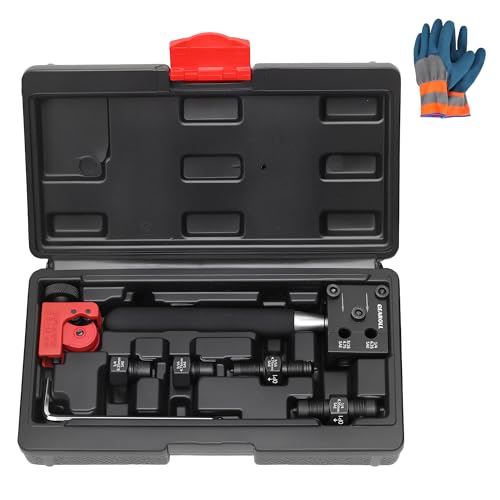
GEAROLL provides a focused option for 3/16″ and 1/4″ tubes, delivering 45° SAE double and single flares as well as bubble flares. The kit includes a flaring cone, a flaring bar (yoke), a tube cutter, and five adapters, plus a chrome swivel to reduce friction. It’s well-suited for typical brake line repairs and hydraulic lines. Note that it’s not recommended for stainless steel and may require careful alignment to prevent slippage during use. A gloves-and-wroing type kit is included for convenience.
- Best for: Diy mechanics replacing smaller-diameter brake lines.
- What to know: Avoid stainless steel tubing unless the kit explicitly supports it.
- Limitations: Proper clamping is essential to prevent flare misalignment.
Clatoon Brake Line Double & Single Flaring Tool Kit

Clatoon’s kit covers a wide range of tubing, including 3/16″, 1/4″, 5/16″, 3/8″, and 1/2″ diameters. It features a heavy-duty flaring bar, a forged yoke, a chrome swivel to reduce friction, and a T-handle for a stable, low-fatigue operation. The included carrying case supports easy organization and transport, making it a good choice for frequent on-site work or shop use. The pack is designed to deliver accurate flares with straightforward setup.
- Best for: Users needing a broad size range and portable storage.
- What to know: Weight and bulk may be more than smaller kits.
- Limitations: Ensure the tubing material is compatible with the dies and yoke.
Fanmoss Brake Line Flaring Tool Kit

The Fanmoss kit emphasizes time savings and versatility, enabling 45-degree single, bubble, and double flares on brake lines, transmission cooler lines, and fuel lines. It supports 3/16″, 1/4″, 5/16″, and 3/8″ tubing in soft metals like copper and aluminum, as well as 304 stainless steel and steel tubing in some configurations. A bench or hitch vise can anchor the setup, and a 6-inch T-handle provides leverage for consistent flares. This makes it a practical option for DIYers who work with multiple metal types.
- Best for: Projects requiring flexibility across tubing materials.
- What to know: Material compatibility can vary; confirm your tubing type before use.
- Limitations: Not all stainless steel applications may be supported by every die set.
Buying Guide: How To Choose The Right Brake Line Flaring Kit
What tubing sizes do you work with most?
Most kits cover common sizes like 3/16″, 1/4″, 5/16″, and 3/8″. If you frequently handle 1/2″ or metric tubing, verify the included dies and adapters before buying.
Where will you flare the tubing?
Bench-mounted or vise-mounted kits provide solid stability. Some kits include portable cases for field work, while others are designed for home workshops. If you work under a car, a bench-only setup may not be suitable.
What materials are you flaring?
Soft metals (copper, aluminum) flare with ease, while hard metals (steel, stainless) require robust dies and precise alignment. If you plan to flare harder materials, confirm compatibility and consider a higher-grade kit.
Ease of use vs. versatility
Some kits prioritize a compact design with fewer dies, ideal for occasional use. Others offer a wide range of dies and a portable case, which is better for frequent or on-site work. Balance your needs for flexibility and portability with budget considerations.
Safety and setup
Always mount the tool securely, wear eye protection, and use gloves. Read the instruction manual carefully to ensure correct die orientation and rotation sequences for single, double, and bubble flares. Keep others clear during operation to avoid debris.
FAQ
- What size brake line can I flare with these kits? Most kits support 3/16″, 1/4″, 5/16″, and 3/8″ tubing; verify the exact dies included before purchase.
- Can I use these tools on a car’s brake lines? Yes, but many kits require bench or vise mounting and are not meant for direct under-vehicle use during operation. Always follow the manufacturer’s mounting guidance.
- Are these suitable for stainless steel tubing? Some kits support stainless steel in limited configurations; others are best for copper, aluminum, or soft steels. Check material compatibility before use.
- Do these kits come with a storage case? Several kits include a hard or blow-molded case for organization and transport, which is helpful for fieldwork.
- Is a vise required to operate? Most kits require a secure vise or bench vise for accurate flares and safety. Always clamp firmly and avoid freehand operation.
- Can I reuse flaring dies for different tubing? Yes, swapping dies is common, but ensure the dies are clean and properly seated to avoid leaks.